Make Corrections, Software: How We Built In-Product Payroll Corrections

Alex Yang
8
min read
Check's mission is to "make payroll, software." Last week, we released the Correction API to partners, which is our latest swing at transforming another piece of payroll operations into software: correcting payroll history.
Correcting payroll history has long been one of the hardest parts of operating a payroll business. Too much of our partners' experience of processing corrections happened outside of our API: through support tickets, manual spreadsheets, and Slack messages.
With the Correction API, partners can now process corrections end-to-end themselves. They can also embed corrections directly into their platforms, so the payroll administrators they serve can request and review, or even create and submit corrections on their own.
Why did we build this?
Most payrolls never need correcting. In a typical quarter at Check, less than 3% of companies require some sort of correction to a payroll that has already been processed.
That said, corrections matter more than their frequency might suggest. Employers and employees don't often think about the hundred payrolls that ran cleanly; they remember the one that went wrong and how their payroll provider handled it. Corrections can also be stressful and urgent for customers. An employee may need a corrected paystub to complete a mortgage application, or may be waiting for a W-2C to file their taxes before the deadline.
A correction handled well is a chance to directly earn an employer's trust, and we want to empower our partners to earn that trust by offering the best possible experience on Check.
It is also a process that, without the proper tooling and infrastructure to support, can take up a tremendous amount of capacity away from a payroll operations team. At Check, we historically have spent thousands of hours on corrections every quarter: reading tickets, going back and forth to pin down what needed to change, and working through manual steps. We knew our partners felt a similar burden from corrections, and it was time to make the investment to build corrections into the product.
One correction, three problems
We began this journey by breaking a correction down into three separate problems:
- Change pay history. Every correction starts with some part of payroll history that is incorrect and needs to be changed. The challenge comes from how that change gets entered and recorded, and how taxes get recalculated and rebalanced after the change is made.
- Calculate money movement. After pay history is corrected, we need to reconcile any changes in tax liabilities with the employer and tax agencies. This might mean collecting new tax liabilities from the employer, or identifying when an agency was overpaid and the employer should expect a refund.
- File amendments and W-2Cs. Tax returns filed in past quarters may need to be amended if a correction affects the data reported, and employees may need to receive W-2Cs for corrections to prior tax years.
Part one: change pay history
We started with a simple question: how should someone tell us what to change?
It turned out to be quite difficult to answer. Payrolls are large and complicated objects, and a correction could be about any combination of things: an incorrect workplace, a misconfigured deduction, a misapplied tax exemption. A single correction could also span hundreds of employees across dozens of paydays at once.
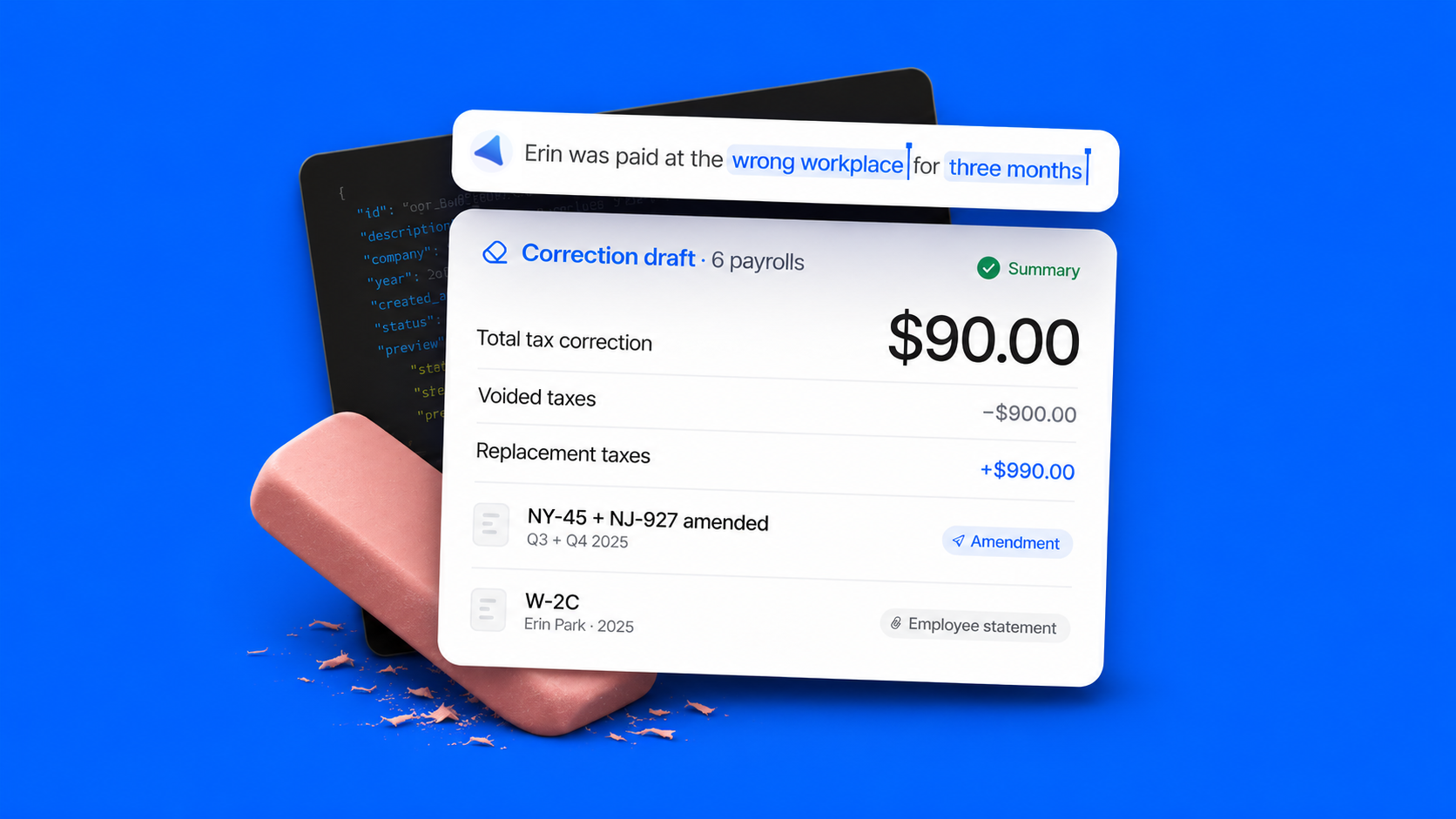
We asked ourselves what the simplest definition of a fix could be that was flexible enough to work in all of these scenarios and could scale to any size. The answer quickly became clear: corrections should just be built out of payrolls. Specifically, two types of payrolls: a void payroll to zero out what was wrong, and a normal payroll to replace it with what it should have been.
That choice came with a lot of benefits that became obvious as we started building. Users enter the exact corrected values they want, so there's no room to make a mistake in the math. Those values are entered through the same Payroll API that partners are already integrated with. The original record is never edited, so the history of a correction is easy to reconstruct. A corrected paystub is available immediately, because the replacement is just another regular payroll.
The lesson we took from this was that extending what already exists in a coherent and logical way is often a better approach than designing something special. Because we built corrections out of ordinary payrolls, everything that already worked for a payroll, from the API to tax calculation to paystubs, worked for a correction, too.
Part two: calculate money movement
Once pay history is corrected, the next hurdle was to be able to determine what the employer owes in new tax liabilities, or what they are owed in refunds. Because everything on a correction is fulfilled together, the amount needs to net out. If a voided paycheck carried $150 in taxes and its replacement carries $165, the employer should see a single $15 debit, not a refund followed by a separate charge.
Calculating this was not as straightforward as it seems. It requires you to know the state of every tax the correction touches: has the liability been collected from the employer yet? Has it been sent to the agency? Did it arise before the employer even started on Check? To answer these questions for any given correction, we built one of the most impressive parts of the Correction API: a fulfillment engine for tax liabilities.
We knew it would be essential to give partners and employers a clear breakdown of the money movement a correction requires, and which tax liabilities it is for. The fulfillment engine factors in all of the different liabilities on a correction, the state of their funding and remittance, and whether they were likely remitted by a prior provider or not based on their date. Then, it produces a single transaction amount with a clear breakdown of the tax liabilities being fulfilled.
This was not something that could be built overnight. The engine only works because it knows the payment frequencies and remittance rules for every tax in every jurisdiction we support. Pulling that payroll-specific research together was a serious undertaking in its own right.
Part three: file amendments and W-2Cs
Finally, the third problem to solve was how to identify the tax filings and W-2s that would need to be amended because of a correction.
Before, a correction and its consequences lived in different places. A ticket described the change. A payment showed up several days later on a bank statement. Amended returns and W-2Cs appeared in a list of filings, with no details on which correction had caused them. Our partners have always wanted those dots connected, and this is where we saw the true potential of having corrections in the product.
Because a correction is an object in our API, everything that follows from it has a source that it can reference. The payment that settles a correction points back to it. So does every amended return and every W-2C. Open a correction in our partner dashboard, Console, and you see the whole chain in one place: what changed, what money moved, and which filings were amended as a result. The same links are in the API, so partners can build that view into their own platforms.
We then took this one step further and started calculating these effects before the correction is even approved. When you preview a correction, Check works out which returns will need to be amended and which employees will receive a W-2C, and produces previews that you can open, download, and send to the employer for verification.
Once you approve, Check files the amended returns and issues the W-2Cs automatically, and you can track their status in the API or Console as well.
Corrections in Check MCP and Checkmate
Once we built these three pillars of the Correction API, we knew it was essential that we make corrections available to agents on our MCP, including Checkmate, our own agent in Console.
That matters a lot because a correction is often more tedious than it is hard. Fixing the pay history of an employee who was paid at the wrong workplace for three months means voiding and replacing every paycheck in that period. An agent can prepare all of that for you easily, pulling the payroll data it needs and building the correction in the Correction API, all from a plain-language request.
The design of the Correction API is also what makes this safe to hand to an agent. The agent works in a draft correction. The preview shows the money movement and the filings that will be amended. Nothing happens until a person reviews it and approves.
None of this came for free with the API, though. Having the tools made Checkmate capable of creating a correction, but we quickly learned that capable is a long way from great. Getting there required dedicated investment in the agent itself: skills that teach it how a correction should be done, evals that measure whether it gets one right, and other work that goes well beyond exposing an endpoint.
What we learned building the Correction API
We're thrilled that the Correction API is now available to our partners, and we can't wait to see the impact it will have on our partners' payroll operations. Reflecting on our experience building this API over the past several months, three lessons stood out along the way, and they will shape how we build what comes next:
- Look for opportunities to extend before building something special. A correction is built out of ordinary payrolls and follows the same preview-then-approve flow. This means partners have less to learn, and the Correction API inherited everything that already worked for a payroll, from tax calculation to paystubs.
- Make effects traceable to their source. In a complicated space like payroll, when one action can have dozens of downstream effects, it’s essential for those to be all clearly linked and explainable in our API. Focusing on achieving that outcome in the Correction API gave partners a tremendous amount of clarity and confidence in the corrections process, which they have long wanted.
- Invest in the agent, not just its tools. Putting corrections in the API gave our AI agent the tools to create one. It didn't automatically make it good at them. That took skills, evals, and dedicated work of its own, and we now plan for that work whenever we want an agent to do something well.
Learn more
Payroll corrections are inevitable, and processing them shouldn't be scary. Instead, they should be an opportunity to provide excellent service and earn your customers' trust.
The Correction API is now live for every partner on Check, and we could not be more excited to see what our partners build with it. To get started, check out the Correcting Pay History guide for the API.
About the author
Alex Yang
Product Manager


Become more for your customers.
Find out how payroll can benefit your customers and your business.