Payroll for Developers → Payroll for Agents
.jpeg)
Ian Zapolsky
min read

Last week, one of our partners asked Checkmate, Check’s new AI agent, why one of their employees’ net pay had dropped forty dollars between two paystubs.
Checkmate pulled the two payroll runs, diffed the earnings and deductions line by line, found a benefit election that had taken effect mid-period, checked the election against the company’s plan configuration, and explained what happened with the specific dollar amounts, the effective date, and a link to the benefit record. Then, because the partner asked, it drafted a customer-facing note to the employee explaining what happened in plain English.
We didn't design Checkmate to handle this case specifically, nor could we have. There are countless ways a paycheck can differ from the previous one, which is exactly why payroll support has always run on people rather than software.
Checkmate is an agent that operates over the entire Check platform, calling tools as it sees fit, so it can take different branching paths to arrive at a solution without being told how to ahead of time, just like a human. This is just one of the things it did on the first week our partners had access to it.
I'm thrilled to announce the launch of Checkmate, available to all Check partners in Check Console and Slack.
I don’t think the interesting story here is that we built an AI agent. The interesting story is what Checkmate reveals about where value in payroll is shifting: away from the generic middle of the stack, and toward the two ends that can't be commoditized — the compliance engine underneath, and the companies who own the customer relationship on top.
The squeeze in the middle
Payroll has traditionally been sold as a bundle. One vendor owned the customer relationship, built the software interfaces customers used to operate payroll, staffed the services organization behind it, and ran the compliance engine that actually computes taxes, moves money, and files tax returns.
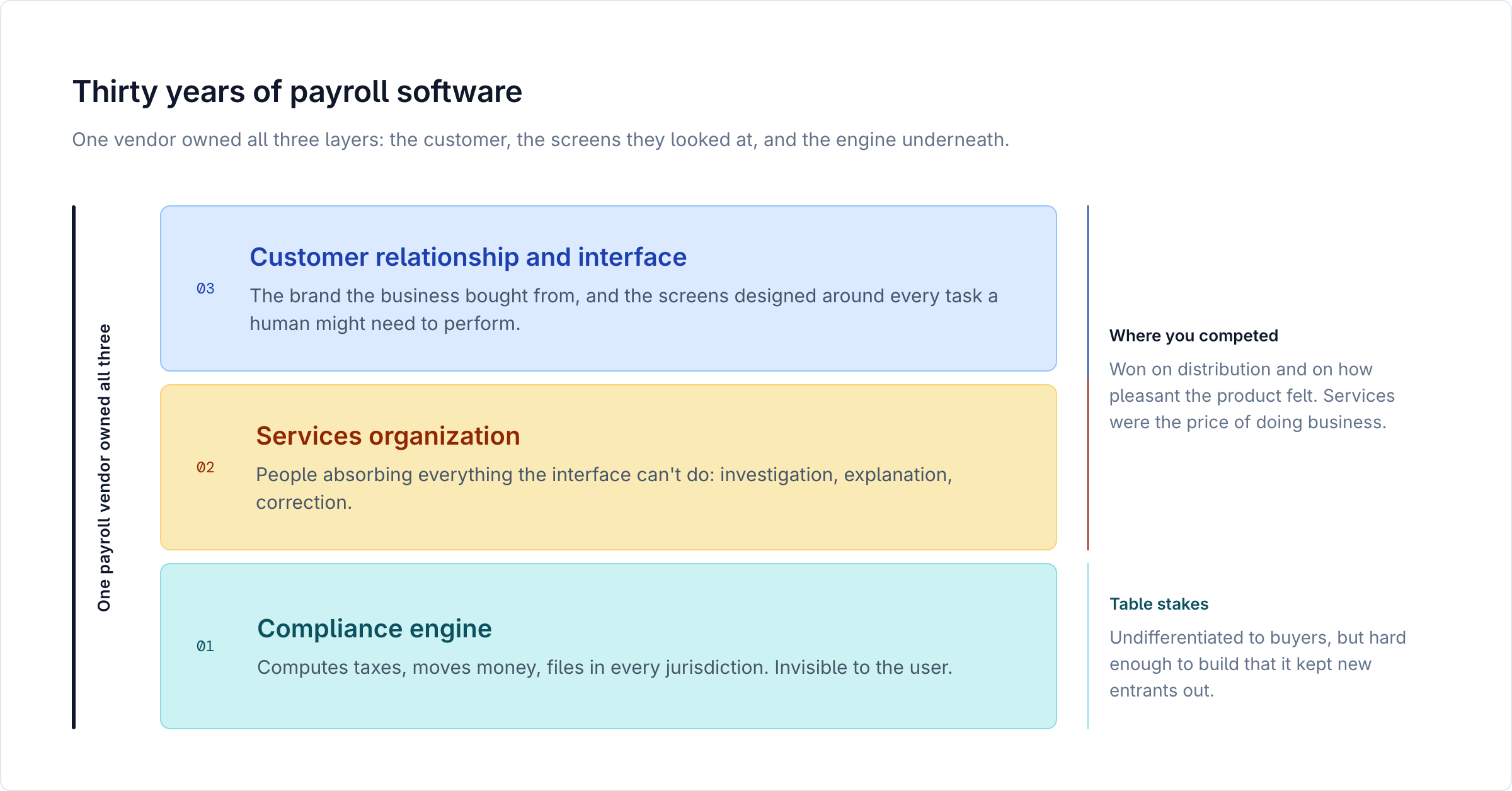
For thirty years, competition happened primarily in the top two layers. Payroll companies won on distribution and on how pleasant the product felt, and they absorbed the cost of a services organization as the price of doing business. Nobody won on the engine. Every serious vendor had one, but no buyer ever picked a provider because its tax logic was more correct than another’s.
AI changes the economics of this bundle.
Start with the interface. AI collapses the cost of building new UI toward zero. That decreases the relative value of a well-built, but generic UI, and increases the relative value of a UI that’s been customized to the needs of a specific user. Once building is easy, knowing your customer becomes the whole game, and the companies that already live inside their customers’ daily workflows have the advantage.
The services layer goes the same direction. Most of what a payroll operations team does is investigation, explanation, and routine correction — exactly the work an agent with full system access is good at. The net pay question at the top of this post used to be a support ticket; now it’s an agent loop with near-zero marginal cost.
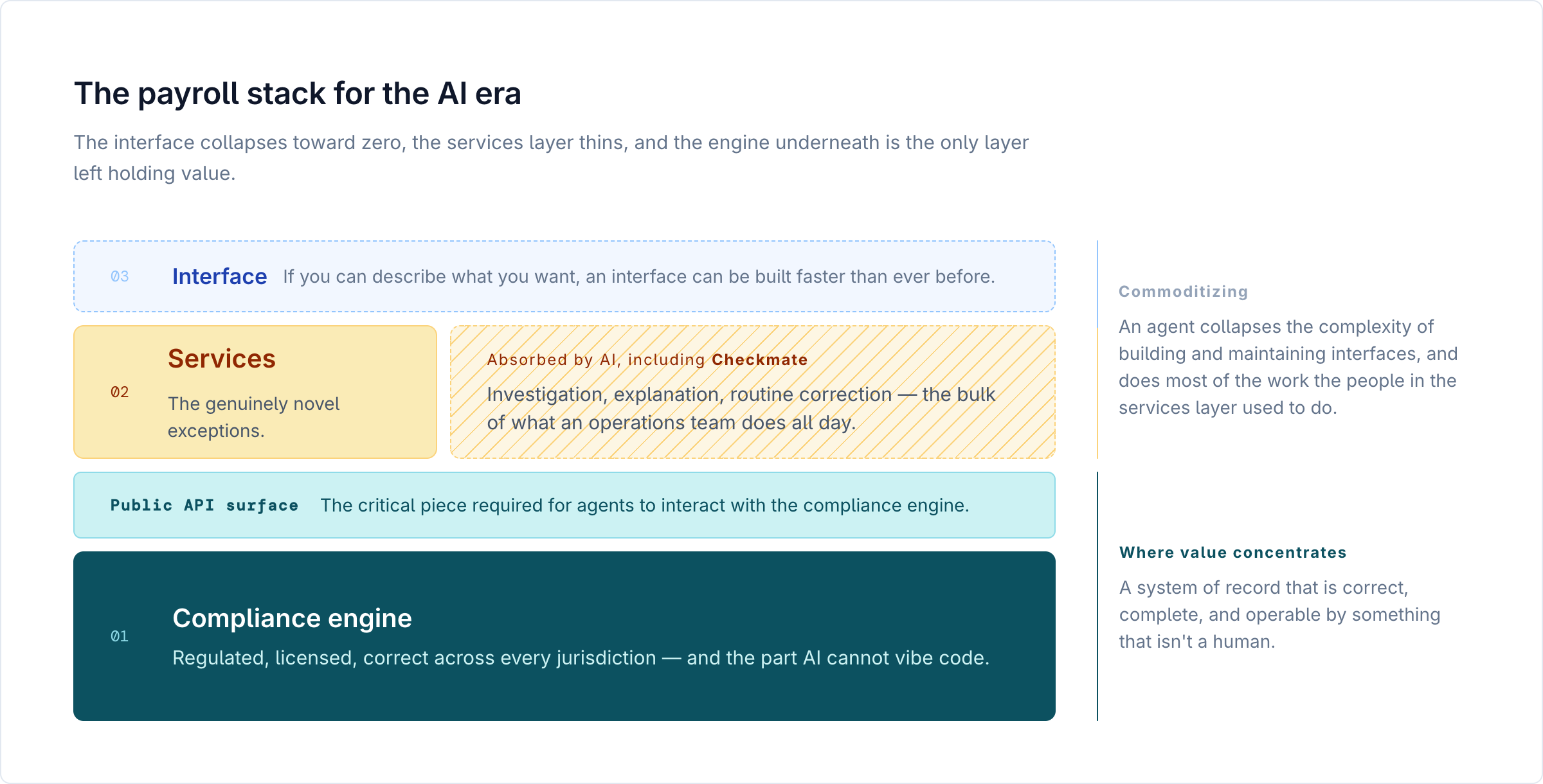
The compliance engine is the part of the software that AI can’t vibe code. At its core, it is a rules database for tax calculation, payments scheduling, and tax filing, which underpins a vast network of integrations with hundreds of federal, state, and local tax agencies, each of which accept data and report errors in different ways. Meanwhile, the money movement infrastructure that powers getting employees paid on time needs to have an extremely high bar of availability and uptime, requires money transmitter licenses that are costly to acquire and maintain, and brings with it natural burdens of credit and fraud loss, which each need to be carefully managed and monitored.
So the middle hollows out, and value moves to the two ends. At the top: whoever owns the customer and deeply understands their needs. At the bottom: whoever owns the infrastructure.
But this comes with a condition. In an increasingly agentic world, the compliance engine is only valuable to the degree that an agent can access it. As the layers above the engine commoditize, value concentrates in whoever owns a system of record that is correct, complete, and fully operable by agents — in other words: a compliance engine built from the ground up with a complete, externalized API wrapped around it.
That’s Check, in a nutshell.
Building for developers → building for agents
Check was founded on a bet that looked strange to the payroll industry in 2019: we would build payroll and never own the interface. Our partners — category-leading workforce management solutions across nearly every vertical you can imagine — would build the experiences their customers saw. We’d build everything underneath.
That goal led us to make thousands of decisions that we didn’t fully appreciate the implications of at the time. Every operation had to be exposed as an API primitive, because a partner’s engineer might need it. Every permission had to be explicit, because we couldn’t assume a Check employee was in the loop. Every action had to be auditable, because it was happening in someone else’s product. It turns out that when you design your system to be used by others from day one, you make fundamental product choices that compound to positively alter the usability, observability, and extensibility of your platform.
We make these decisions so that our partners’ developers can build great products on top of our infrastructure. It turns out that they are close to the same set of decisions we would make to enable an agent to do the same.
Agents need complete, permissioned, auditable API interfaces. Yes, an agent can drive a UI the way a person does, but in a regulated domain, a client that clicks through screens is slow, brittle, and leaves no audit trail. Without these things, agents can only be chatbots, fetching information from documentation but not capable of taking real action on behalf of users.
We’ve spent the first seven years of Check's existence building exactly this platform for reasons that had nothing to do with AI. But the moment the models got good enough, we found that we already had a platform that was agent-ready, and the only remaining work was to point an agent at it.
What Checkmate actually is
Checkmate is an AI agent, grounded in thousands of pages of API documentation and proprietary help center content, running against Check’s MCP server. It reads and writes production data with the permissions of the person using it. It can look up any object in the system, explain any calculation, and take any action that a developer with a Check API key can take — run a payroll, correct an employee’s setup, investigate and resolve a blocked filing, retry failed payments, etc. It’s tested against hundreds of evaluation test cases derived from our extensive dataset of the trickiest payroll support questions.
Checkmate is a highly knowledgeable, accurate, and smart user of the Check platform. But its true power comes not from the AI inside it, but rather the public API it has access to: Check’s API.
That distinction matters a lot. We see many payroll and HR incumbents releasing AI chatbots right now. The majority of these agents are capable of looking up information, and performing actions through pre-defined operating procedures and internal endpoints. They are not truly dynamic. And even if they are, they are most often relying on tools that are internally exposed and non-public.. Until a company puts their functionality into a fully externalized, publicly documented API, their platform is not agent-accessible. In other words (in Steve Yegge’s words, to be precise), they have a product, not a platform.
Building for agents and the next generation of our partners
Here’s where we see the world going.
Up until now, Check’s growth has come from a simple pattern: a software company that owns a customer relationship decides it should offer payroll, and rather than spend three years building a compliance engine, it builds on ours.
That pattern doesn’t change with AI. It just changes who’s building and operating the experience. Increasingly, the "someone else" building and servicing the experience on top of Check will be an agent — ours, a partner's, or one that an end customer brings themselves. The payroll experience of the next decade will be conversational, dynamic, embedded in whatever tool a business already lives in, and driven by software that can act rather than just answer.
Innovative Check partners like Mercury, Warp, Miter, Workstream, Homebase, and others are on the bleeding edge of this frontier, and many others will continue to push on what’s possible with these new tools.
Every one of those agents needs a substrate. They need a system of record that is correct across every jurisdiction.
We’ve been building this for developers since 2019, and we will continue to build this for developers and agents in the 2020s and beyond. We believe what’s coming next is the most exciting period of innovation we’ve seen yet, as our partners build agents that interoperate with our platform, and work directly with Checkmate, to create the most dynamic, delightful, and efficient payroll businesses we’ve ever seen.
About the author
Ian Zapolsky
Chief Growth Officer

Become more for your customers.
Find out how payroll can benefit your customers and your business.